

Blog Categories:

How to Set Financial Goals That Actually Stick
Setting financial goals sounds like something you should do - but for many small business owners, it’s often vague, rushed, or simply forgotten in the day-to-day hustle.
But here’s the truth: when done right, setting financial goals for small business growth is one of the most powerful ways to stay focused, increase profitability, and build long-term success.
In this guide, we’ll show you how to set financial goals that are clear, motivating, and (most importantly) achievable.

Setting financial goals sounds like something you should do, but for many small business owners - it’s often vague, rushed, or simply forgotten in the day-to-day hustle.
But here’s the truth: when done right, setting financial goals for small business growth is one of the most powerful ways to stay focused, increase profitability, and build long-term success.
In this guide, we’ll show you how to set financial goals that are clear, motivating, and (most importantly) achievable.
💡 Why Financial Goals Matter
Without clear financial goals, it’s easy to:
Overspend on non-essentials
Underprice your services
Miss growth opportunities
Get caught in survival mode instead of scaling mode
Financial goals serve as your roadmap. They give your business direction, track your progress, and help you course-correct when things go off track.
📌 Step 1: Know Your “Why”
Before diving into spreadsheets or sales targets, start with your business’s bigger purpose.
Ask yourself:
What do I want this business to fund - freedom, growth, a legacy?
Am I working toward hiring a team? Paying off debt? Expanding locations?
Your goals should align with your vision, not someone else’s benchmark.
📊 Step 2: Review Your Financial Baseline
To set realistic and measurable goals, you need to know where you’re starting from.
Review:
Revenue: What are your monthly and annual earnings?
Expenses: Fixed vs. variable
Profit margins: Gross and net
Cash flow trends: Are you stable or struggling with timing?
Use accounting software like QuickBooks, Xero, or Wave to pull reports quickly and accurately.
🎯 Step 3: Set SMART Financial Goals
Vague goals like “make more money” or “grow the business” don’t work. Use the SMART framework to bring clarity:
Specific – What exactly do you want to achieve?
Measurable – Can you track it with numbers?
Achievable – Is it realistic based on current performance?
Relevant – Does it align with your long-term goals?
Time-bound – What’s your deadline?
Example:
Instead of “Increase sales,” try:
“Increase monthly revenue from $10K to $15K by Q3 through new service packages.”
🪜 Step 4: Break Goals Into Action Steps
Big financial goals can feel overwhelming. Break them down into smaller, manageable milestones:
Example Goal: Save $20,000 for a new location
Breakdown:
Save $5,000 per quarter
Reduce unnecessary expenses by 10%
Add one new recurring client per month
Each small win builds momentum and keeps your team (or yourself) motivated.
🛠 Step 5: Track Progress Regularly
Goals don’t stick without accountability. Build time into your month to check in.
Review monthly profit & loss statements
Compare actuals vs. goals
Identify what’s working…and what’s not
Adjust timelines or tactics if needed
Using a financial dashboard or goal-tracking template makes this process simple and visual.
🚫 Common Mistakes to Avoid
When setting financial goals for small business, avoid these pitfalls:
Setting unrealistic goals: Stretch is good, fantasy is not
Not writing them down: What gets written, gets done
Focusing only on revenue: Profit, cash flow, and debt matter too
Ignoring the numbers: Use data, not just instincts
📌 Goal Ideas to Get You Started
If you’re not sure what kinds of financial goals to set, here are a few to inspire you:
Increase gross profit margin by 5%
Grow monthly recurring revenue (MRR) to $10K
Cut operating expenses by 15%
Set aside 3 months of emergency savings
Pay off $25K in business debt in 12 months
Launch a new revenue stream by Q2
Pick one or two high-impact goals to focus on at a time.
🧠 Final Thoughts: Clarity Creates Confidence
Setting financial goals isn’t about creating pressure, it’s about creating clarity. When you know your targets, you can make decisions with confidence, measure what matters, and celebrate wins that actually move the needle.
Whether you're just starting or scaling up, setting financial goals for small business is one of the smartest ways to grow with purpose.
Start today with one specific, measurable goal. Then build from there. Future-you will thank you.
📌 Want to Know If Your Business Is Really Healthy?
At Breakspears Bookkeeping Services LLC, we help you:
✅ Track profit and cash flow side by side
✅ Get paid faster
✅ Build financial systems that support growth
👉 Explore our flat-rate bookkeeping packages
👉 Book a free discovery call to take control of your numbers - without the overwhelm.

What Investors Really Want to See in Your Finances
So you're ready to pitch your business to investors? Great. But before you talk valuations and big visions, there’s one thing investors will ask to see first: your numbers.
That’s where business finance preparation for investors comes in. Your ability to present clear, accurate, and compelling financials can be the difference between a quick “yes” and a polite “pass.”
Here’s what investors are really looking for - and how you can prepare your finances to impress them.

So you're ready to pitch your business to investors? Great. But before you talk valuations and big visions, there’s one thing investors will ask to see first: your numbers.
That’s where business finance preparation for investors comes in. Your ability to present clear, accurate, and compelling financials can be the difference between a quick “yes” and a polite “pass.”
Here’s what investors are really looking for, and how you can prepare your finances to impress them.
💡 Why Financial Preparation Matters
Investors aren’t just buying into your idea—they’re betting on your ability to manage money and generate returns. Your financial statements tell a story: not just where your business is today, but where it's going.
Solid financial preparation helps you:
Build investor trust
Demonstrate financial maturity
Justify your valuation
Speed up the due diligence process
The better prepared you are, the more professional and fundable your business appears.
📊 The Key Financial Documents Investors Expect
Let’s start with the essentials. These are the financial reports every investor will want to see, no matter your industry or stage.
✅ 1. Profit & Loss Statement (P&L)
Shows your revenue, expenses, and net income over time. Investors want to see:
Growing revenues
Healthy margins
Expense discipline
✅ 2. Balance Sheet
Details your assets, liabilities, and equity. It answers questions like:
What does the business own?
What debts or obligations exist?
How is the company funded so far?
✅ 3. Cash Flow Statement
Arguably more important than profitability - investors want to know:
Are you generating positive cash flow?
How fast are you burning cash?
Can you sustain operations without constant funding?
✅ 4. Financial Forecasts (12–36 months)
Show investors where you’re headed. These should include:
Revenue projections
Expense forecasts
Break-even analysis
Key assumptions clearly explained
📁 Bonus Materials That Add Credibility
Go beyond the basics and impress with well-prepared supplementary documents:
Cap Table: Breakdown of equity ownership
Use of Funds Summary: How you’ll spend investor money
Customer Acquisition Cost (CAC) & Lifetime Value (LTV): Unit economics show your growth model
KPI Dashboards: Real-time visibility into performance (great if you already track metrics like churn, retention, or MRR)
🚫 Common Mistakes That Turn Investors Off
Avoid these pitfalls when preparing your financials:
Inconsistencies or errors: Double-check all numbers
Overly optimistic projections: Investors can smell fluff
Missing data: Don’t make them dig, give a full picture
No clear path to profitability: Even startups need a plan
Remember: clarity > complexity. You’re not trying to impress with jargon—you’re building trust.
🧠 What Investors Want to Understand (Not Just See)
Beyond the spreadsheets, investors want to understand your financial thinking.
Ask yourself:
Can I explain how I arrived at my forecasts?
Do I know my gross margin and why it matters?
What’s my plan if revenue falls short next quarter?
Being fluent in your own financials shows leadership and preparation - traits investors love.
📌 Tips for Investor-Ready Financials
✔️ Be transparent
Highlight challenges honestly. Investors appreciate realism.
✔️ Update regularly
Use recent data - ideally within the last 30–60 days.
✔️ Use visuals
Charts and dashboards make data digestible and memorable.
✔️ Get a second set of eyes
Have a CPA or financial advisor review everything before pitching.
🛠 Tools to Help You Prepare
You don’t need to build everything from scratch. These tools can streamline your process:
QuickBooks / Xero: Generate P&L, balance sheet, and cash flow reports
LivePlan: Create investor-ready forecasts and pitch decks
Fathom / Dryrun / Float: Turn financials into visuals
Google Sheets: Great for custom models and collaborative forecasting
🎯 Final Thoughts: Financial Clarity = Investor Confidence
If you want investors to write checks, you need to show them more than potential, you need to show a plan backed by numbers.
Business finance preparation for investors is about telling a story they can believe in. One that says:
“We know what we’re doing.”
“We know where we’re going.”
“And we’ll use your money wisely.”
Take the time to prepare your financials right. When the questions come, and they will: you’ll be ready with answers that impress.
📌 Want to Know If Your Business Is Really Healthy?
At Breakspears Bookkeeping Services LLC, we help you:
✅ Track profit and cash flow side by side
✅ Get paid faster
✅ Build financial systems that support growth
👉 Explore our flat-rate bookkeeping packages
👉 Book a free discovery call to take control of your numbers - without the overwhelm.

Top 10 Business Finance Apps That Actually Save You Time
Let’s face it, running a business is hard enough without wasting hours managing your finances. The good news? There are apps built specifically to make money management faster, easier, and even kind of enjoyable.
Whether you're a freelancer, solopreneur, or small business owner, the best apps for business finances in 2025 help you stay on top of income, expenses, taxes, and more - with minimal effort.
Here are 10 apps worth checking out if you want to spend less time crunching numbers and more time growing your business.

Let’s face it, running a business is hard enough without wasting hours managing your finances. The good news? There are apps built specifically to make money management faster, easier, and even kind of enjoyable.
Whether you're a freelancer, solopreneur, or small business owner, the best apps for business finances in 2025 help you stay on top of income, expenses, taxes, and more - with minimal effort.
Here are 10 apps worth checking out if you want to spend less time crunching numbers and more time growing your business.
1. QuickBooks Online
Best for: All-in-one accounting for small businesses
QuickBooks remains the gold standard for cloud accounting. It automates invoicing, tracks expenses, manages payroll, and integrates with nearly every tool you use.
Why it saves you time:
Bank syncing for real-time updates
Built-in tax tools
Recurring invoices and reports
✅ Bonus: Clean dashboards and mobile-friendly design
2. FreshBooks
Best for: Service-based businesses and freelancers
FreshBooks is loved for its user-friendly interface and simple invoicing. It also offers time tracking, expense management, and client communication tools.
Why it saves you time:
Track time, send invoices, and accept payments in one place
Automated late payment reminders
Mileage tracking for easy deductions
3. Xero
Best for: Businesses with global operations or multiple users
Xero offers powerful accounting features with great scalability. It's perfect for growing teams and works seamlessly with over 1,000 third-party apps.
Why it saves you time:
Bulk reconciliation of bank transactions
Real-time collaboration with bookkeepers
Multi-currency support
4. Wave
Best for: Budget-conscious entrepreneurs
Wave is a free accounting solution with surprisingly robust features. It covers invoicing, payments, and basic bookkeeping - perfect for early-stage businesses.
Why it saves you time:
Automated expense tracking
Seamless bank integration
No fees for core features
5. Expensify
Best for: Expense tracking and reimbursements
Expensify is ideal for business owners or teams who travel or spend on behalf of the company. Snap a picture of a receipt, and it’s instantly logged and categorized.
Why it saves you time:
One-tap expense reports
SmartScan for receipts
Company card syncing
6. Bonsai
Best for: Freelancers and creatives
Bonsai is more than finance, it’s a full freelance business suite. But its expense tracking and tax estimates are fantastic if you want to manage everything in one place.
Why it saves you time:
Auto-import expenses
Pre-filled tax estimates
Contracts and invoices included
7. Zoho Books
Best for: Small businesses wanting customization
Zoho Books is part of the larger Zoho ecosystem. It’s a powerful, flexible option with tons of automation and customization options.
Why it saves you time:
Auto-scheduling of recurring transactions
Smart dashboards and insights
Built-in time tracking and project billing
8. Float
Best for: Cash flow forecasting
Float connects to your accounting software to give you real-time cash flow projections. It’s a game-changer if you want to plan smarter.
Why it saves you time:
Visual, forward-looking insights
What-if scenario planning
Real-time sync with QuickBooks, Xero, and FreeAgent
9. Pleo
Best for: Team expense management
Pleo is perfect for teams. It offers smart company cards and automates expense reports, no more chasing receipts or mystery charges.
Why it saves you time:
Auto-categorization of team expenses
Instant spending visibility
Set card limits and control spending in real time
10. Hurdlr
Best for: Self-employed professionals and side hustlers
Hurdlr automates mileage, income, and expense tracking - especially great for gig workers, Uber drivers, or solo consultants.
Why it saves you time:
Auto-tracking of earnings and write-offs
Real-time tax estimates
Simple, mobile-first interface
🧠 How to Choose the Right App for You
With so many great options, how do you choose? Start by asking:
Do I need just expense tracking or full accounting?
Do I manage a team or just myself?
What tools do I already use (and need to integrate)?
Do I prefer free tools or am I ready to invest?
Don’t be afraid to try a few - most offer free trials or free tiers.
Final Thoughts: Save Time, Stay Organized, Stress Less
The best apps for business finances in 2025 aren’t just about tracking numbers - they’re about freeing up your time and mental space. With the right tools in place, your finances become less of a chore and more of a strategic advantage.
Start with the app that fits your current needs, and let your system grow as your business does. Time is money, so why not save both?
📌 Want to Know If Your Business Is Really Healthy?
At Breakspears Bookkeeping Services LLC, we help you:
✅ Track profit and cash flow side by side
✅ Get paid faster
✅ Build financial systems that support growth
👉 Explore our flat-rate bookkeeping packages
👉 Book a free discovery call to take control of your numbers - without the overwhelm.

How to Track Business Expenses Like a Pro
You’re working hard to grow your business, but if you’re not tracking your expenses properly, you could be leaving money on the table - or worse, heading for a financial mess.
Whether you're just starting out or scaling fast, knowing how to track small business expenses is a skill every entrepreneur needs. The good news? You don’t need to be an accountant to do it well - you just need the right system.
In this guide, we’ll show you how to track expenses like a pro, using simple steps and tools that fit your business.

You’re working hard to grow your business, but if you’re not tracking your expenses properly, you could be leaving money on the table, or worse, heading for a financial mess.
Whether you're just starting out or scaling fast, knowing how to track small business expenses is a skill every entrepreneur needs. The good news? You don’t need to be an accountant to do it well, you just need the right system.
In this guide, we’ll show you how to track expenses like a pro, using simple steps and tools that fit your business.
💡 Why Tracking Business Expenses Matters
Tracking your expenses isn’t just for tax season. It helps you:
Understand where your money is going
Spot waste or overspending
Prepare for taxes and audits
Make smart, data-driven decisions
Maximize your deductions
If you want to grow profitably, expense tracking isn’t optional: it’s essential.
🧾 Step 1: Separate Personal and Business Finances
This is step zero - before you even track anything, you need to separate your personal and business money.
Why?
Mixing finances makes it hard to track expenses, claim deductions, or prove legitimacy in case of an audit.
How to do it:
Open a dedicated business checking account
Use a business credit card for all purchases
Avoid using personal accounts for any business-related costs
📂 Step 2: Choose an Expense Tracking Method
There are three main ways to track expenses, depending on your comfort level and business size:
✅ 1. Manual (Spreadsheets)
Good for freelancers or side hustlers. Track income and expenses in a Google Sheet or Excel file.
Pros: Free, customizable
Cons: Time-consuming, easy to make errors
✅ 2. Accounting Software
Ideal for growing businesses. Popular options include:
QuickBooks Online
Xero
FreshBooks
Wave (free for basic use)
Pros: Automation, accuracy, reports
Cons: Monthly fees, learning curve
✅ 3. Expense Tracking Apps
Use standalone apps like Expensify or Bonsai to snap receipts, categorize spending, and sync with your accounting system.
🔍 Step 3: Categorize Your Expenses
To make your data useful and deductible, group your expenses into categories. These often mirror what the IRS uses on tax forms.
Common expense categories:
Office supplies
Marketing and advertising
Travel and meals
Software and subscriptions
Contractor payments
Utilities and rent
Most accounting software lets you set custom rules to automatically categorize recurring expenses.
📸 Step 4: Keep and Digitize Receipts
Receipts are proof of purchase, and required for certain tax deductions. Instead of letting them pile up, digitize them.
How to stay organized:
Use apps to scan receipts (like QuickBooks, Expensify, or Hubdoc)
Attach digital copies to transactions
Store in cloud folders (Google Drive, Dropbox) if needed
Pro tip: The IRS accepts digital copies, so no need for shoeboxes full of paper.
🔄 Step 5: Reconcile Monthly
Reconciling means matching your expense records with your bank and credit card statements to catch errors, missed entries, or fraud.
Monthly reconciliation helps you:
Ensure data accuracy
Spot cash flow issues
Avoid end-of-year surprises
Set a recurring time each month to review and tidy up your books: 15–30 minutes is usually enough.
🧠 Step 6: Analyze and Adjust
Tracking expenses is only valuable if you use the data. Each month, review where your money went and whether those expenses align with your business goals.
Questions to ask:
What can I cut or reduce?
Are my expenses leading to ROI?
Am I on budget?
Should I adjust pricing or spending?
Turn your numbers into smarter business decisions.
📌 Bonus Tips for Expense Tracking Success
Automate where possible: Link bank accounts to software for real-time tracking
Create a system for reimbursements: Especially if you have team members
Label everything clearly: Avoid vague terms like “miscellaneous”
Keep it consistent: The more regularly you track, the easier it gets
Final Thoughts: Tracking Expenses Is a Power Move
Learning how to track small business expenses doesn’t just keep you compliant - it puts you in control. With a clear view of your spending, you can reduce waste, boost profitability, and run your business like a true pro.
Start with small steps. Pick a method, stay consistent, and evolve your system as your business grows. Financial clarity starts here.
📌 Want to Know If Your Business Is Really Healthy?
At Breakspears Bookkeeping Services LLC, we help you:
✅ Track profit and cash flow side by side
✅ Get paid faster
✅ Build financial systems that support growth
👉 Explore our flat-rate bookkeeping packages
👉 Book a free discovery call to take control of your numbers - without the overwhelm.

5 Budgeting Mistakes That Are Costing You Thousands
Every dollar matters when you’re running a small business. But even the most well-meaning business owners make budgeting mistakes that quietly chip away at their profits. The good news? Once you recognize these issues, they’re easy to fix.
In this article, we’ll break down five common small business budgeting mistakes - and how you can correct them before they cost you any more money.

Every dollar matters when you’re running a small business. But even the most well-meaning business owners make budgeting mistakes that quietly chip away at their profits. The good news? Once you recognize these issues, they’re easy to fix.
In this article, we’ll break down five common small business budgeting mistakes - and how you can correct them before they cost you any more money.
💸 Mistake #1: Not Having a Budget at All
Let’s start with the obvious, many small businesses simply don’t have a formal budget. Operating without one is like driving without a map: you might move forward, but you have no idea where you're going or how much it's costing you.
Why it's costly:
Overspending on non-essential expenses
Underestimating fixed costs
Difficulty identifying financial leaks
Fix it:
Create a simple monthly or quarterly budget that includes:
Projected income
Fixed expenses (rent, payroll, subscriptions)
Variable expenses (marketing, travel, supplies)
Emergency buffer
Even a basic spreadsheet is better than flying blind.
🔍 Mistake #2: Underestimating Expenses
Optimism is great for entrepreneurs - but when it comes to budgeting, too much optimism can hurt. Many small businesses underestimate costs or forget to include irregular expenses entirely.
Commonly missed expenses:
Software renewals
Tax payments
Equipment maintenance
Annual insurance premiums
Why it’s costly:
Surprise expenses lead to cash flow issues or debt reliance.
Fix it:
Review your last 12 months of expenses and build in seasonal or annual costs. Add a 10–15% cushion for unexpected items.
⌛ Mistake #3: Ignoring Cash Flow Timing
Even profitable businesses can go under if their cash flow isn’t timed properly. A budget that shows positive income means nothing if your receivables come in after your bills are due.
Why it’s costly:
Missed payments or late fees
Reliance on credit
Stressful juggling of bills
Fix it:
Build a cash flow forecast alongside your budget:
When will cash actually come in?
When are expenses due?
Will you have enough cash on hand?
Tools like QuickBooks or Float can help automate this process.
📉 Mistake #4: Failing to Track Budget vs. Actuals
Creating a budget is just the first step: monitoring it is where the magic happens. If you’re not comparing your projected vs. actual performance, you’re missing critical insights.
Why it’s costly:
Small overages become habitual
Missed chances to correct course
No accountability
Fix it:
Do a monthly or quarterly budget review:
Where did you overspend?
Where did you save?
What trends are emerging?
Adjust future budgets accordingly.
🚫 Mistake #5: Not Budgeting for Growth
Many small business owners budget for survival, not scaling. If your budget only covers “getting by,” you’ll struggle to invest in marketing, hiring, or product development.
Why it’s costly:
Missed growth opportunities
No room to innovate
Stalled momentum
Fix it:
Add a line item for growth:
Marketing experiments
Software upgrades
Education or training
Outsourcing tasks to free up your time
Growth doesn’t happen by accident, it needs a place in your budget.
✅ Quick Recap: 5 Budgeting Mistakes to Avoid
No budget at all
Underestimating or forgetting expenses
Ignoring cash flow timing
Not reviewing actual vs. planned spending
Failing to budget for growth
Final Thoughts: Budgeting Is a Growth Tool, Not a Restriction
Budgeting isn’t about saying no - it’s about making smarter yes decisions. By avoiding these common small business budgeting mistakes, you gain clarity, control, and confidence in your financial direction.
Start small. Track progress. Adjust often. Your budget can become one of your most powerful business tools.
📌 Want to Know If Your Business Is Really Healthy?
At Breakspears Bookkeeping Services LLC, we help you:
✅ Track profit and cash flow side by side
✅ Get paid faster
✅ Build financial systems that support growth
👉 Explore our flat-rate bookkeeping packages
👉 Book a free discovery call to take control of your numbers - without the overwhelm.

How to Create a Financial Dashboard for Your Business
As a small business owner, you wear many hats, but your decision-making should always be grounded in real numbers. That’s where a financial dashboard for small business comes in. It’s not just another spreadsheet or report - it's your real-time snapshot of business health.
In this post, you'll learn why a financial dashboard matters, what to include, and how to build one that helps you make faster, smarter financial decisions.

You didn’t start your business to spend hours sorting receipts or panicking over spreadsheets. But if you’re losing track of your finances, or just your sanity - it might be time to ask the big question: When should I hire a bookkeeper for business finances?
If you're unsure whether you’re ready, you’re in the right place. This guide will walk you through the signs that it’s time to bring in a pro, and what you gain when you do.
🚩 1. You're Spending Too Much Time on Bookkeeping
Time is your most valuable asset as a business owner. If you’re spending hours each week reconciling transactions, managing invoices, or trying to understand your cash flow, you’re likely working outside your zone of genius.
Hiring a bookkeeper frees you to:
Focus on revenue-generating tasks
Grow your client base
Sleep better at night
When your time is better spent on strategy than spreadsheets, it’s time to consider professional help.
💡 2. You’re Not Sure if You’re Profitable
It’s possible to have money coming in and still be operating at a loss. If you can’t clearly answer questions like:
“What’s my net income this month?”
“What’s driving most of my expenses?”
“Can I afford to hire someone next quarter?”
...then you’re flying blind. A bookkeeper organizes your finances so you can make confident, data-driven decisions.
📉 3. Tax Season Is a Nightmare
If tax time fills you with dread - or worse, surprise….you’re not alone. Many small business owners wait until the last minute to pull everything together.
Bookkeepers help you:
Track deductions year-round
Prepare financial statements for your CPA
Avoid penalties for late or incorrect filings
When to hire a bookkeeper for business finances? Ideally, before tax season stress hits.
🧾 4. Your Books Are Always Behind (or Nonexistent)
Are you months behind on updating your books? Are your transactions living in your bank account without any categorization?
Late or messy books:
Skew your financial reports
Cause you to miss tax write-offs
Make it harder to get loans or funding
Bookkeepers keep your records up to date, clean, and accurate, all year long.
💰 5. You’re Ready to Scale
As your business grows, your finances get more complex. More clients, more vendors, maybe even payroll, these changes demand tighter financial oversight.
A bookkeeper can help you:
Prepare for hiring
Track profitability by project or service
Maintain clean records for investors or lenders
Scaling without financial clarity can stunt growth. Bring in a bookkeeper to build a stronger foundation.
👤 6. You're Unsure About Software or Compliance
Do you feel overwhelmed by bookkeeping tools like QuickBooks, Wave, or Xero? Are you confident you're meeting IRS guidelines?
A bookkeeper:
Uses tools efficiently
Ensures transactions are properly categorized
Helps you stay compliant with tax laws
If your answer to “Am I doing this right?” is I have no idea, it’s time for expert support.
🔄 7. You Want to Make Better Business Decisions
Your financial data holds the answers to key questions like:
Where can I cut costs?
Which services or products are most profitable?
How much can I invest in marketing?
But you can’t act on data you don’t have. A bookkeeper turns your numbers into actionable insights you can use to grow with confidence.
So, When Should You Hire a Bookkeeper?
Here’s the short answer:
You should hire a bookkeeper when managing your finances becomes a source of stress, confusion, or lost time, and before it costs you money.
Whether you’re:
A solo freelancer drowning in receipts
A startup with growing revenue
A small business ready to scale
...a bookkeeper can provide clarity, control, and peace of mind.
✅ Quick Checklist: Signs You’re Ready for a Bookkeeper
You’re spending 5+ hours/month on bookkeeping
Your books are never up to date
Tax season overwhelms you
You’re not sure where your money is going
You want help preparing for growth
Final Thoughts: Invest in Clarity, Not Just Compliance
Hiring a bookkeeper isn’t just about avoiding financial mistakes - it’s about running your business with clarity and confidence. If you’ve been wondering when to hire a bookkeeper for business finances, the answer might be: right now.
Your future self (and your accountant) will thank you.
📌 Want to Know If Your Business Is Really Healthy?
At Breakspears Bookkeeping Services LLC, we help you:
✅ Track profit and cash flow side by side
✅ Get paid faster
✅ Build financial systems that support growth
👉 Explore our flat-rate bookkeeping packages
👉 Book a free discovery call to take control of your numbers—without the overwhelm.

Are You Ready for a Bookkeeper? Here’s How to Tell
You didn’t start your business to spend hours sorting receipts or panicking over spreadsheets. But if you’re losing track of your finances, or just your sanity - it might be time to ask the big question: When should I hire a bookkeeper for business finances?
If you're unsure whether you’re ready, you’re in the right place. This guide will walk you through the signs that it’s time to bring in a pro - and what you gain when you do.

You didn’t start your business to spend hours sorting receipts or panicking over spreadsheets. But if you’re losing track of your finances, or just your sanity - it might be time to ask the big question: When should I hire a bookkeeper for business finances?
If you're unsure whether you’re ready, you’re in the right place. This guide will walk you through the signs that it’s time to bring in a pro, and what you gain when you do.
🚩 1. You're Spending Too Much Time on Bookkeeping
Time is your most valuable asset as a business owner. If you’re spending hours each week reconciling transactions, managing invoices, or trying to understand your cash flow, you’re likely working outside your zone of genius.
Hiring a bookkeeper frees you to:
Focus on revenue-generating tasks
Grow your client base
Sleep better at night
When your time is better spent on strategy than spreadsheets, it’s time to consider professional help.
💡 2. You’re Not Sure if You’re Profitable
It’s possible to have money coming in and still be operating at a loss. If you can’t clearly answer questions like:
“What’s my net income this month?”
“What’s driving most of my expenses?”
“Can I afford to hire someone next quarter?”
...then you’re flying blind. A bookkeeper organizes your finances so you can make confident, data-driven decisions.
📉 3. Tax Season Is a Nightmare
If tax time fills you with dread - or worse, surprise….you’re not alone. Many small business owners wait until the last minute to pull everything together.
Bookkeepers help you:
Track deductions year-round
Prepare financial statements for your CPA
Avoid penalties for late or incorrect filings
When to hire a bookkeeper for business finances? Ideally, before tax season stress hits.
🧾 4. Your Books Are Always Behind (or Nonexistent)
Are you months behind on updating your books? Are your transactions living in your bank account without any categorization?
Late or messy books:
Skew your financial reports
Cause you to miss tax write-offs
Make it harder to get loans or funding
Bookkeepers keep your records up to date, clean, and accurate, all year long.
💰 5. You’re Ready to Scale
As your business grows, your finances get more complex. More clients, more vendors, maybe even payroll, these changes demand tighter financial oversight.
A bookkeeper can help you:
Prepare for hiring
Track profitability by project or service
Maintain clean records for investors or lenders
Scaling without financial clarity can stunt growth. Bring in a bookkeeper to build a stronger foundation.
👤 6. You're Unsure About Software or Compliance
Do you feel overwhelmed by bookkeeping tools like QuickBooks, Wave, or Xero? Are you confident you're meeting IRS guidelines?
A bookkeeper:
Uses tools efficiently
Ensures transactions are properly categorized
Helps you stay compliant with tax laws
If your answer to “Am I doing this right?” is I have no idea, it’s time for expert support.
🔄 7. You Want to Make Better Business Decisions
Your financial data holds the answers to key questions like:
Where can I cut costs?
Which services or products are most profitable?
How much can I invest in marketing?
But you can’t act on data you don’t have. A bookkeeper turns your numbers into actionable insights you can use to grow with confidence.
So, When Should You Hire a Bookkeeper?
Here’s the short answer:
You should hire a bookkeeper when managing your finances becomes a source of stress, confusion, or lost time, and before it costs you money.
Whether you’re:
A solo freelancer drowning in receipts
A startup with growing revenue
A small business ready to scale
...a bookkeeper can provide clarity, control, and peace of mind.
✅ Quick Checklist: Signs You’re Ready for a Bookkeeper
You’re spending 5+ hours/month on bookkeeping
Your books are never up to date
Tax season overwhelms you
You’re not sure where your money is going
You want help preparing for growth
Final Thoughts: Invest in Clarity, Not Just Compliance
Hiring a bookkeeper isn’t just about avoiding financial mistakes - it’s about running your business with clarity and confidence. If you’ve been wondering when to hire a bookkeeper for business finances, the answer might be: right now.
Your future self (and your accountant) will thank you.
📌 Want to Know If Your Business Is Really Healthy?
At Breakspears Bookkeeping Services LLC, we help you:
✅ Track profit and cash flow side by side
✅ Get paid faster
✅ Build financial systems that support growth
👉 Explore our flat-rate bookkeeping packages
👉 Book a free discovery call to take control of your numbers—without the overwhelm.

What Reports Should You Be Reviewing Monthly?
Running a small business is like steering a ship, you need a clear view of where you are, where you’ve been, and where you’re heading. That’s where monthly financial reports for small business owners come in. These reports aren’t just paperwork - they’re your financial compass.
If you're unsure what you should be reviewing every month, you're not alone. In this post, we’ll break down the essential financial reports that keep your business on track and thriving.

Running a small business is like steering a ship - you need a clear view of where you are, where you’ve been, and where you’re heading. That’s where monthly financial reports for small business owners come in. These reports aren’t just paperwork: they’re your financial compass.
If you're unsure what you should be reviewing every month, you're not alone. In this post, we’ll break down the essential financial reports that keep your business on track and thriving.
Why Monthly Financial Reports Matter
Think of your business like a car. Would you drive cross-country without checking the fuel gauge or engine temperature? Monthly financial reports offer the same kind of oversight - warning you about problems before they become emergencies.
Key benefits include:
Catching issues early (like cash flow shortages)
Making informed budgeting and investment decisions
Tracking business growth and profitability
Staying prepared for tax season and investor conversations
1. Profit and Loss Statement (P&L)
Also known as the income statement, the Profit and Loss Statement shows how much money your business earned and spent over the month.
What to look for:
Total revenue vs. total expenses
Gross profit margin
Net income (or loss)
Trends in income and expense categories
Why it matters:
It gives you a snapshot of profitability and helps you identify areas where you're overspending or underperforming.
2. Balance Sheet
The Balance Sheet shows your business’s financial position at a specific point in time. It details assets, liabilities, and owner’s equity.
Key components:
Assets (cash, inventory, equipment)
Liabilities (loans, credit card debt, unpaid bills)
Equity (what the business actually owns after debts)
Why it matters:
This report tells you how financially stable your business is. It’s also critical for securing loans or attracting investors.
3. Cash Flow Statement
Revenue is great, but it doesn't mean much if your bank account is empty. The Cash Flow Statement shows how cash moves in and out of your business.
What to monitor:
Operating activities (day-to-day cash flow)
Investing activities (asset purchases, investments)
Financing activities (loans, owner's draws or injections)
Why it matters:
Even profitable businesses can fail due to poor cash flow. This report helps ensure you always have enough to cover payroll, rent, and bills.
4. Accounts Receivable Aging Report
Are your customers paying on time? The Accounts Receivable (A/R) Aging Report breaks down who owes you money and how long they’ve owed it.
Sections often include:
Current
30 days past due
60 days past due
90+ days past due
Why it matters:
Unpaid invoices can cripple your cash flow. Reviewing this monthly helps you follow up on overdue payments and avoid bad debt.
5. Accounts Payable Aging Report
This report shows what you owe to vendors and suppliers. It helps you prioritize payments and avoid late fees or strained relationships.
What it tracks:
Outstanding bills
Due dates
Vendor balances
Why it matters:
Staying on top of payables improves vendor relationships and helps you manage cash more effectively.
6. Budget vs. Actual Report
This comparison report helps you measure your actual performance against your planned budget for the month.
What to analyze:
Revenue and expense variances
Over- or under-spending in specific categories
Forecasting accuracy
Why it matters:
It reveals how well you're sticking to your financial plan and helps you course-correct for future months.
7. Sales Report
A monthly Sales Report helps you see what products or services are performing best and where growth is happening, or slowing down.
Look for:
Top-performing products or services
Sales by channel or salesperson
Monthly sales trends
Why it matters:
Understanding your revenue drivers lets you double down on what’s working and tweak what isn’t.
Pro Tip: Automate Report Generation
Most accounting platforms like QuickBooks, Xero, or Wave can automate these monthly reports, so you’re not starting from scratch every month. Schedule them to be sent directly to your inbox so you never skip a review.
How to Use These Reports Together
Individually, each report tells part of your financial story. Together, they paint the full picture. Use them as part of a monthly financial review meeting, even if you're a solopreneur.
Suggested monthly routine:
Review reports from the previous month
Identify trends or red flags
Make adjustments to spending or operations
Set goals for the upcoming month
Final Thoughts: Monthly Reports, Major Impact
If you want to grow your business with intention - not just instinct, then monthly financial reports for small business owners are non-negotiable. They help you move from reactive to proactive, from chaos to clarity.
Start small. Even reviewing just your P&L and cash flow statement each month can transform how you run your business.
📌 Want to Know If Your Business Is Really Healthy?
At Breakspears Bookkeeping Services LLC, we help you:
✅ Track profit and cash flow side by side
✅ Get paid faster
✅ Build financial systems that support growth
👉 Explore our flat-rate bookkeeping packages
👉 Book a free discovery call to take control of your numbers—without the overwhelm.

The Financial Checklist Every Freelancer Needs
Freelancing gives you freedom, but with that independence comes responsibility, especially when it comes to your finances. Whether you're a graphic designer, copywriter, or developer, staying on top of your money isn’t just smart - it’s essential for long-term success.
That’s why we created the ultimate Freelancer Business Finance Checklist to help you stay organized, compliant, and in control. No accounting degree required, just a commitment to financial clarity.

Freelancing gives you freedom, but with that independence comes responsibility, especially when it comes to your finances. Whether you're a graphic designer, copywriter, or developer, staying on top of your money isn’t just smart: it’s essential for long-term success.
That’s why we created the ultimate Freelancer Business Finance Checklist to help you stay organized, compliant, and in control. No accounting degree required - just a commitment to financial clarity.
✅ 1. Open a Dedicated Business Bank Account
One of the first financial moves every freelancer should make is separating personal and business finances. Mixing the two creates confusion and can raise red flags with the IRS.
Action Steps:
Open a business checking account
Use it exclusively for freelance income and expenses
Consider getting a business credit card for larger purchases
✅ 2. Set Up a Bookkeeping System
Good bookkeeping is the backbone of any successful freelance business. Whether you use software like QuickBooks, Wave, or a spreadsheet, consistency is key.
Your system should track:
Income (clients, platforms, referrals)
Expenses (software, supplies, education, etc.)
Mileage (if you drive for business purposes)
Invoices and payment status
✅ 3. Track Every Expense
Freelancers often miss out on valuable deductions simply because they don’t track their spending. A key part of any Freelancer Business Finance Checklist is capturing every legitimate expense.
Common deductible expenses include:
Home office costs (a portion of rent, utilities)
Internet and phone
Business meals and travel
Software subscriptions
Professional development
Use apps like Expensify, Bonsai, or QuickBooks Self-Employed to automate this.
✅ 4. Create and Send Invoices Promptly
Getting paid is priority #1, so your invoicing process should be smooth and timely.
Best practices:
Send invoices immediately after completing work
Include clear payment terms (net 7, net 15, etc.)
Use tools like FreshBooks or HoneyBook to automate invoices
Follow up on late payments with a firm, friendly reminder
✅ 5. Set Aside Money for Taxes
Unlike a traditional job, taxes aren’t withheld from your freelance income. That means it’s your job to prepare for quarterly payments and year-end filing.
Tax checklist items:
Set aside 25–30% of your income for federal and state taxes
Pay estimated quarterly taxes (April, June, September, January)
Track all deductible expenses to reduce taxable income
Consider hiring a tax professional
✅ 6. Save for Retirement
Freelancers don’t get employer 401(k)s, but that doesn’t mean you can’t save for the future. In fact, you have several options that come with tax benefits.
Retirement options for freelancers:
SEP IRA
Solo 401(k)
Traditional or Roth IRA
Even small, consistent contributions will add up - and help lower your taxable income.
✅ 7. Build a Cash Reserve
Freelance income can be unpredictable. A financial buffer will help you weather slow months or surprise expenses without panic.
Aim to save:
3–6 months of living and business expenses
Keep it in a high-yield savings account for easy access
✅ 8. Review Financials Monthly
Make it a habit to sit down once a month and review your finances. This is where you spot patterns, track growth, and identify areas to improve.
Monthly checklist:
Reconcile bank and credit card statements
Review income and expenses
Check outstanding invoices
Adjust budget or spending if needed
✅ 9. Prepare for Year-End and Taxes
Don’t wait until April to start thinking about taxes. Year-end prep should begin in December, or earlier if you’re planning ahead.
End-of-year to-do’s:
Collect 1099s from clients
Download bank and expense reports
Confirm all transactions are categorized
Schedule time with your CPA or tax pro
✅ 10. Keep Financial Documents Organized
Whether digital or paper, a well-organized system can save you hours of headaches during tax season or an audit.
Organize and store:
Receipts
Contracts
Tax documents
Bank and credit statements
Cloud-based storage like Google Drive or Dropbox makes this easy and secure.
Final Thoughts: Make Finances Your Freelance Superpower
Staying on top of your finances doesn’t have to be overwhelming. With this Freelancer Business Finance Checklist, you can bring order to the chaos, stay compliant, and build a sustainable freelance business that supports your goals: financial and otherwise.
Start with one section today and build momentum. The sooner you take control, the more freedom you’ll actually enjoy.
📌 Want to Know If Your Business Is Really Healthy?
At Breakspears Bookkeeping Services LLC, we help you:
✅ Track profit and cash flow side by side
✅ Get paid faster
✅ Build financial systems that support growth
👉 Explore our flat-rate bookkeeping packages
👉 Book a free discovery call to take control of your numbers—without the overwhelm.

How to Fix Messy Business Finances Before Tax Season
Let’s be honest - running a small business means wearing many hats. But when it comes to tax season, one hat no entrepreneur can afford to ignore is financial cleanup. If your books are a mess and receipts are scattered, you're not alone. The good news? Cleaning up small business finances for taxes is totally doable and can even save you money, stress, and time.
Here’s how to get your finances in order before the IRS/HMRC (or your accountant) comes knocking.

Let’s be honest - running a small business means wearing many hats. But when it comes to tax season, one hat no entrepreneur can afford to ignore is financial cleanup. If your books are a mess and receipts are scattered, you're not alone. The good news? Cleaning up small business finances for taxes is totally doable, and can even save you money, stress, and time.
Here’s how to get your finances in order before the IRS (or your accountant) comes knocking.
1. Start With a Financial Reality Check
Before diving into spreadsheets or software, pause and take stock. Ask yourself:
Are all your transactions recorded?
Have you been separating personal and business expenses?
Is your bank account reconciled?
Do you have a bookkeeping system in place?
Being honest about the state of your finances is the first step toward fixing them. Don’t worry if things aren’t perfect - clarity is better than chaos.
2. Categorize Income and Expenses Accurately
This might sound basic, but miscategorized expenses are one of the top reasons small business owners leave money on the table at tax time. Review each transaction and assign it the proper category:
Office supplies
Software subscriptions
Contractor payments
Meals and entertainment
Travel
Make sure you're consistent. Most tax software and CPAs rely on these categories to find deductions and ensure compliance.
Pro Tip: Use IRS Schedule C categories as a guide for consistency and simplicity.
3. Reconcile Your Accounts
Reconciling means matching your internal records with your bank and credit card statements. This ensures that no transactions are missed, duplicated, or mis-recorded. It’s a crucial step in cleaning up small business finances for taxes.
Look for:
Duplicate entries
Missing transactions
Incorrect amounts
Your bookkeeping software may offer reconciliation tools, but manual cross-checking is often necessary for accuracy.
4. Separate Personal and Business Finances
Still using one account for both personal and business expenses? Stop right now. Not only does this create a documentation nightmare, but it also raises red flags with auditors.
To clean things up:
Open a dedicated business checking account
Get a business credit card
Transfer any personal transactions out of your books
Going forward, keep all business activity within the business accounts. It’ll make next tax season infinitely easier.
5. Digitize and Organize Receipts
The IRS doesn’t require paper receipts, but you do need to prove expenses. If your receipts are living in your glovebox or crumpled in a drawer, now’s the time to digitize.
Use tools like:
Expensify
Shoeboxed
QuickBooks mobile app
Scan, categorize, and attach receipts to corresponding transactions. If you ever face an audit, this habit will pay off in a big way.
6. Review Payroll and Contractor Payments
Mishandling employee wages or contractor payments is a fast track to tax penalties. Double-check:
W-2s for employees
1099-NECs for contractors
Payroll tax withholdings and filings
Make sure all workers are properly classified, and all payments are documented. Misclassification is a common IRS audit trigger.
7. Consult a Professional (Yes, Really)
Even if you’re a DIY business owner, hiring a CPA or bookkeeper, especially before tax season, can help clean up your finances and spot deductions you didn’t even know existed.
Look for someone who:
Specializes in small business tax law
Uses cloud-based accounting software
Offers year-round support, not just during tax season
Think of it as an investment, not a cost.
8. Automate Moving Forward
Once you’ve cleaned up the mess, don’t let it happen again. Automate what you can:
Connect bank accounts to accounting software
Schedule recurring invoice reminders
Set up monthly reconciliations
Automate expense tracking with apps
Cleaning up small business finances for taxes is hard enough once, you don’t want to do it again next year.
Final Thoughts: A Clean Slate = A Clear Mind
Tax season doesn’t have to be a panic-inducing ordeal. By cleaning up your small business finances ahead of time, you gain more than just compliance - you gain peace of mind, potential savings, and a stronger handle on your business health.
Start today. Future you (and your accountant) will thank you.
💬 Think of it this way: Profit is a theory, cash is reality.
📌 Want to Know If Your Business Is Really Healthy?
At Breakspears Bookkeeping Services LLC, we help you:
✅ Track profit and cash flow side by side
✅ Get paid faster
✅ Build financial systems that support growth
👉 Explore our flat-rate bookkeeping packages
👉 Book a free discovery call to take control of your numbers—without the overwhelm.

Profit Isn’t Cash: Here’s Why That Matters
You’ve just reviewed your profit & loss statement. It says your business made $8,000 in profit last month.
So why does your bank account feel like it’s gasping for air?
Welcome to the difference between profit and cash flow: one of the most misunderstood (and dangerous) concepts in small business finance.
If you’ve ever wondered why your books say you’re “profitable” but your wallet says otherwise, this blog is for you. Let’s break it down - no jargon, just real talk, and show you why knowing the difference can save your business.
You’ve just reviewed your profit & loss statement. It says your business made $8,000 in profit last month.
So why does your bank account feel like it’s gasping for air?
Welcome to the difference between profit and cash flow: one of the most misunderstood (and dangerous) concepts in small business finance.
If you’ve ever wondered why your books say you’re “profitable” but your wallet says otherwise, this blog is for you. Let’s break it down - no jargon, just real talk, and show you why knowing the difference can save your business.
💸 What Is Profit?
Profit is what’s left over after your business pays its expenses.
On a basic level:
Revenue – Expenses = Profit
Your profit appears on your Profit & Loss Statement (P&L) and is based on what you’ve earned and spent, whether or not the cash has actually moved.
💡 Example: You send a $2,000 invoice to a client this month. That counts as revenue, even if they haven’t paid it yet.
💵 What Is Cash Flow?
Cash flow is the movement of actual money in and out of your bank account. It shows how much cash you have on hand to spend, save, or reinvest.
Cash flow is tracked on your Cash Flow Statement and tells you:
When money is received from clients
When money is paid out to suppliers, staff, rent, or tools
💡 You can be profitable on paper, but if your cash flow is negative: you can’t pay your bills, make payroll, or grow.
📊 Profit vs. Cash Flow: What’s the Real Difference?
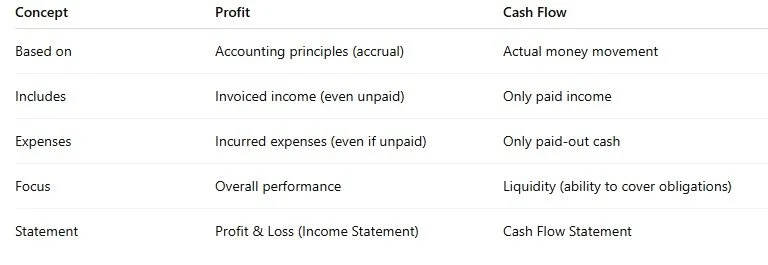
💬 Think of it this way: Profit is a theory, cash is reality.
🚨 Why This Difference Matters to Small Businesses
1. You Can Be Profitable and Still Go Broke
A business can show $50,000 in profit - but if that money hasn’t actually arrived yet, and you can’t pay rent, you’re in trouble.
This is especially common when:
Clients pay invoices late
You’ve made big upfront investments (like inventory or equipment)
You’re growing quickly but not collecting fast enough
2. Cash Flow Problems Kill More Businesses Than Profitability Issues
It’s estimated that 82% of small business failures are due to poor cash flow management, not lack of profit.
💡 A business that consistently runs out of cash is at risk, even if it's profitable on paper.
3. Lenders & Investors Care More About Cash
Profit looks good in reports, but lenders want to see how much cash you have to repay loans. A strong cash flow history is key if you want to grow using funding.
🧠 What Causes the Gap Between Profit and Cash?
Here are some common culprits:
Late-paying clients
High accounts receivable (money owed to you)
Inventory purchases that don’t count as “expenses” yet
Loan repayments that don’t appear on your P&L
Owner draws or dividends that affect cash but not profit
💡 This is why both statements (P&L + Cash Flow) matter. One tells the story, the other tells the timing of that story.
✅ How to Stay on Top of Profit and Cash Flow
Here are some quick tips to manage both like a pro:
1. Review Both Reports Monthly
Don’t rely on just your P&L. Ask your bookkeeper for a cash flow report too.
2. Use Cloud Accounting Tools
QuickBooks Online and Xero let you generate real-time profit and cash flow insights.
3. Get Paid Faster
Set payment terms that work for you (net-7 or net-15)
Use invoicing tools with payment links
Send automated reminders
4. Create a Cash Buffer
Set aside at least one month of operating expenses so you’re not stressed when payments are late or unexpected costs pop up.
5. Work with a Bookkeeper Who Explains the Numbers
At Breakspears Bookkeeping Services LLC, we don’t just send your reports: we walk you through them so you actually know what’s going on in your business.
💬 Final Thoughts: Know Your Numbers, Protect Your Business
Understanding the difference between profit and cash flow isn’t just a nice-to-have, it’s essential if you want to keep your business healthy and stress-free.
Profit shows how well your business performs.
Cash flow shows whether it can survive.
And the businesses that know both? They’re the ones that grow sustainably and confidently.
📌 Want to Know If Your Business Is Really Healthy?
At Breakspears Bookkeeping Services LLC, we help you:
✅ Track profit and cash flow side by side
✅ Get paid faster
✅ Build financial systems that support growth
👉 Explore our flat-rate bookkeeping packages
👉 Book a free discovery call to take control of your numbers—without the overwhelm.

How to Hire Financial Help Without Blowing Your Budget
Running a small business means wearing a lot of hats, but the finance hat?…..That one can feel a little too tight.
You know you need help with your numbers: whether it’s organizing your books, getting ready for tax season, or just making sense of your cash flow. But you also don’t want to break the bank just to get your finances in order.
The good news? Affordable financial help for small business owners does exist - you just need to know where to look, what to prioritize, and how to avoid overpaying for services you don’t actually need.
Let’s walk through how to hire the right kind of financial support, without blowing your budget in the process.
Running a small business means wearing a lot of hats, but the finance hat?…..That one can feel a little too tight.
You know you need help with your numbers: whether it’s organizing your books, getting ready for tax season, or just making sense of your cash flow. But you also don’t want to break the bank just to get your finances in order.
The good news? Affordable financial help for small business owners does exist - you just need to know where to look, what to prioritize, and how to avoid overpaying for services you don’t actually need.
Let’s walk through how to hire the right kind of financial support, without blowing your budget in the process.
💸 Why DIYing Your Finances Might Be Costing You More
It’s tempting to do it all yourself, especially when you’re just starting out. But DIY bookkeeping and finance management comes with hidden costs:
Wasted time (that could be spent on revenue-generating work)
Missed deductions or write-offs
Late payments or missed invoices
Tax penalties
Overwhelm, burnout, and procrastination
💡 If you’re spending more than 5–7 hours a month trying to manage your books and you still feel unsure, you’re already “paying” more than you should.
🧾 Step 1: Know What Kind of Help You Actually Need
Not every small business needs a full-time CFO. Before hiring anyone, get clear on your current pain points.
Here’s a quick cheat sheet:

💡 For most freelancers, solopreneurs, and creative businesses, a good bookkeeper and a tax pro are all you need to start.
💼 Step 2: Consider a Remote Bookkeeping Service
Outsourcing your bookkeeping is often the most cost-effective option for small businesses.
Why? You get:
Flat monthly fees
No payroll or overhead costs
Professional support
More time back in your day
Breakspears Bookkeeping Services LLC, for example, offers affordable monthly packages designed specifically for small businesses who want clarity without complexity.
💡 Many of our clients save $500–$1,000+ annually just by avoiding mistakes, late fees, and missed deductions.
🔍 Step 3: Compare Costs….But Don’t Just Pick the Cheapest Option
Here’s what affordable financial help for small business typically costs:

💡 Look for fixed-rate services that include everything you need, surprise hourly bills are the budget-breakers.
✨ Step 4: Ask the Right Questions Before Hiring
Whether you're hiring a freelancer, firm, or part-time support, make sure to ask:
“What’s included in your monthly fee?”
“How do you communicate with clients?”
“Do you specialize in small businesses or side hustles?”
“Will you help me understand my numbers, not just track them?”
“What software do you use and is it included?”
💡 You don’t need someone who just inputs numbers, you need someone who explains what those numbers actually mean.
🧠 Step 5: Prioritize Clarity Over Complexity
The most valuable thing a financial pro can give you? Peace of mind.
You want someone who can:
Help you feel confident at tax time
Show you where your money is going
Identify areas to save or grow
Make sure nothing falls through the cracks
💬 At Breakspears Bookkeeping Services, our motto is: no jargon, no overwhelm, just clean books and straight answers.
💬 Final Thoughts: Smart Money Help That Won’t Break the Bank
Getting help with your finances isn’t a luxury: it’s a smart move that can actually save you money in the long run.
When you stop guessing, stop stressing, and stop spending hours on tasks outside your zone of genius, you create space to grow, scale, and enjoy the business you’re building.
Affordable financial help for small business is out there, and it’s more accessible than you think.
📌 Need Help Managing Your Finances Without Breaking Your Budget?
At Breakspears Bookkeeping Services LLC, we specialize in helping:
✅ Solo entrepreneurs
✅ Creative small business owners
✅ Side hustlers and freelancers
…get clear, affordable financial support with flat-rate monthly packages and QuickBooks expertise.
👉 Explore our bookkeeping packages
👉 Book a free 15-minute call to find the right support without overspending.

How to Calculate Your Break-Even Point (The Easy Way)
Ever wonder how much you need to sell just to cover your costs? That is where the break-even point comes in.
Understanding how to calculate business break-even point is essential for freelancers, side hustlers, and small business owners who want to run their businesses with confidence.
Let’s break down the numbers step by step - no complicated jargon, no math headaches, just a simple guide you can actually use.

Ever wonder how much you need to sell just to cover your costs? That is where the break-even point comes in.
Understanding how to calculate business break-even point is essential for freelancers, side hustlers, and small business owners who want to run their businesses with confidence.
Let’s break down the numbers step by step. No complicated jargon, no math headaches - just a simple guide you can actually use.
💡 What is the Break-Even Point?
The break-even point is the moment your revenue equals your costs. At this point, you are not making a profit yet - but you are not losing money either.
Anything you sell beyond your break-even point is profit.
Why is this important?
✅ It tells you how much you must sell to stay afloat.
✅ It helps you set realistic sales goals.
✅ It shows you if your pricing is sustainable.
🧮 The Break-Even Formula (Don’t Worry, It’s Easy)
Here’s the simple formula for how to calculate business break-even point:

Let’s break this down in plain English:
✅ Fixed Costs: Costs that do not change with sales volume (like rent, software, insurance).
✅ Variable Costs: Costs that increase as you sell more (like materials, packaging, or transaction fees).
✅ Price per Unit: What you charge for your product or service.
🏗️ A Real-Life Example
Let’s say you run an online shop selling handmade candles:
Fixed costs (website, rent, insurance): $2,000 per month
Variable cost per candle (wax, jar, label): $5
Price per candle: $20
Your break-even point is:

So, you need to sell at least 134 candles a month to break even.
🏆 Why Knowing Your Break-Even Point Matters
Once you know your break-even point, you can:
✅ Set clear sales targets
✅ Adjust pricing if your margins are too small
✅ Plan for growth (by increasing prices or cutting costs)
✅ Avoid cash flow problems by staying ahead of expenses
It also helps you avoid working “for free” without realizing it.
📊 How to Make Break-Even Work for Your Business
Here’s a simple action plan:
✅ Step 1: List all your fixed costs
✅ Step 2: Calculate your variable costs per product or service
✅ Step 3: Apply the formula
✅ Step 4: Set a monthly sales goal based on your break-even point (plus profit!)
Bonus tip: If your break-even point seems high, it might be time to:
Raise your prices
Lower your costs
Focus on higher-margin products or services
🚀 Final Thoughts
Understanding how to calculate business break-even point is one of the most powerful tools you can have as a small business owner.
Once you know your numbers, you can set smarter goals, manage your cash flow, and build a sustainable, profitable business.
No more guessing - just clarity, control, and confidence.

What’s a Chart of Accounts? And Why Your Business Needs One
If you're a small business owner trying to stay on top of your finances, you’ve probably heard the term “chart of accounts” thrown around, especially if you're setting up QuickBooks, Xero, or chatting with your bookkeeper.
But what is it exactly? And do you really need one if you’re just starting out?
Short answer: Yes.
Longer answer: It’s the foundation of how your finances are organized…and it can save you time, stress, and money.
Let’s break down what a chart of accounts for small business actually is, why it matters, and how to set one up (without the overwhelm).
If you're a small business owner trying to stay on top of your finances, you’ve probably heard the term “chart of accounts” thrown around, especially if you're setting up QuickBooks, Xero, or chatting with your bookkeeper.
But what is it exactly? And do you really need one if you’re just starting out?
Short answer: Yes.
Longer answer: It’s the foundation of how your finances are organized…and it can save you time, stress, and money.
Let’s break down what a chart of accounts for small business actually is, why it matters, and how to set one up (without the overwhelm).
📚 What Is a Chart of Accounts?
A chart of accounts (COA) is simply a list of categories that your business uses to classify every financial transaction. It’s like the filing cabinet for your money: organizing everything from income and expenses to assets and liabilities.
Think of it as your business’s financial map. It helps you see:
Where your money is coming from
Where it’s going
What your business owns or owes
How profitable you really are
Each account has a name and a type, and it falls into one of these main categories:
Assets – what your business owns (bank accounts, inventory)
Liabilities – what you owe (credit cards, loans)
Equity – your business’s net worth
Income (Revenue) – how your business earns money
Expenses – what you spend to run your business
🧠 Why Your Business Needs a Chart of Accounts
You might be thinking: “Can’t I just track my income and expenses without setting up all these categories?”
Technically yes, but here’s why that’s not a great idea:
✅ 1. It Keeps You Organized (and Sanity Intact)
Without a COA, every transaction becomes a free-for-all. A proper chart lets you track every dollar with clarity and confidence.
✅ 2. It Makes Tax Time Way Easier
Your tax deductions (meals, software, advertising, mileage) need to be tracked by category. A solid COA helps you (or your CPA) pull clean records and maximize deductions.
✅ 3. It Helps You Make Smarter Decisions
Want to know if you’re spending too much on tools? Or which service brings in the most money? Your chart of accounts gives you the data you need to adjust, plan, and grow.
✅ 4. It’s Essential for Accounting Software
QuickBooks, Xero, and Wave all run on a chart of accounts. If you’re using software (which you should), a COA is the foundation.
💡 At Breakspears Bookkeeping Services LLC, we create and customize COAs that are tailored to your business, not just the default template.
🧾 What Does a Basic Chart of Accounts Look Like?
Here’s a simplified example of what a chart of accounts might look like for a freelance graphic designer:
Assets:
1000 – Business Checking Account
1010 – PayPal Account
1100 – Accounts Receivable
Liabilities:
2000 – Business Credit Card
2100 – Sales Tax Payable
Equity:
3000 – Owner’s Equity
3100 – Owner’s Draw
Income:
4000 – Design Services
4100 – Template Sales
4200 – Affiliate Income
Expenses:
5000 – Software Subscriptions
5100 – Advertising & Marketing
5200 – Office Supplies
5300 – Professional Services
5400 – Internet & Utilities
Each number and category serves a purpose. Once set up, every transaction you enter will be assigned to one of these accounts.
🛠️ How to Set Up a Chart of Accounts for Small Business
Start with a basic template.
Most accounting tools will give you one, don’t overcomplicate it.Customize based on your industry.
A fitness coach’s COA will look different from a photographer’s. Add or rename accounts as needed.Stay consistent.
Don’t change categories every month. Keep it simple and stick with it.Review and revise annually.
As your business grows, your chart of accounts should evolve too.
💡 Need help setting yours up? We offer custom chart of accounts creation and walkthroughs as part of our monthly packages.
🧠 Pro Tips from a Bookkeeper
Keep it lean: You don’t need 50+ categories. Too much detail becomes unmanageable.
Use sub-accounts sparingly for extra clarity (e.g., "Marketing" → "Social Ads," "Print Ads")
Reconcile regularly so nothing slips through the cracks
Review reports monthly to spot patterns or surprises
Use your COA to inform your budget and financial goals
💬 Final Thoughts: A Small Step That Makes a Big Difference
Your chart of accounts for small business might seem like a small, technical setup - but it’s actually one of the most powerful tools in your financial toolbox.
It helps you stay organized, make better decisions, prepare for taxes, and understand your money without the overwhelm. Whether you're just starting out or you're scaling fast, your COA gives structure to your success.
📌 Need Help Setting Up Your Chart of Accounts?
At Breakspears Bookkeeping Services, LLC, we help freelancers, creatives, and small business owners:
✅ Set up QuickBooks Online
✅ Build a custom chart of accounts
✅ Categorize transactions for clarity and compliance
👉 Explore our flat-fee bookkeeping packages
👉 Book a free 15-minute call to get your books set up the right way—right from the start.

Why Most Side Hustles Fail Financially (And How to Avoid It)
Starting a side hustle is exciting. You’re finally turning that idea into income - whether it’s selling products online, offering freelance services, or monetizing a creative skill.
But while starting is easy… staying profitable is where most people stumble.
The truth? Most side hustles fail not because the idea is bad: but because the finances are messy, ignored, or misunderstood.
So if you’re growing a side hustle and want to avoid the most common money pitfalls, read on. These business finance tips for side hustles will help you stay in control, stay profitable, and build something that actually lasts.
Starting a side hustle is exciting. You’re finally turning that idea into income - whether it’s selling products online, offering freelance services, or monetizing a creative skill.
But while starting is easy… staying profitable is where most people stumble.
The truth? Most side hustles fail not because the idea is bad: but because the finances are messy, ignored, or misunderstood.
So if you’re growing a side hustle and want to avoid the most common money pitfalls, read on. These business finance tips for side hustles will help you stay in control, stay profitable, and build something that actually lasts.
🚩 The Most Common Financial Mistakes Side Hustlers Make
Before we dive into the fixes, here are the biggest financial red flags I see when working with new side business owners:
❌ Mixing personal and business finances
All your earnings and expenses live in one bank account, and you’re constantly guessing what’s what.
❌ No tracking of expenses or income
You might be using Venmo, your personal PayPal, or forgetting to record purchases altogether.
❌ Forgetting to save for taxes
You spend the full amount of every payment you receive and are blindsided by tax bills later.
❌ No financial planning or goal setting
You don’t know your profit margin, can’t predict cash flow, and aren’t sure how much you need to earn to make it worthwhile.
💡 Sound familiar? You’re not alone, and the good news is, these are all fixable.
✅ 7 Business Finance Tips for Side Hustles That Want to Succeed
Let’s break down what you should be doing instead….whether you’re earning $200 a month or building your side hustle toward full-time income.
1. Open a Separate Business Bank Account
Seriously, this one action will make everything easier.
Why it matters:
Keeps your transactions organized
Helps you track what’s actually business-related
Makes tax time 10x less painful
💡 You don’t need an LLC to open a business account, many banks offer options for sole proprietors or freelancers.
2. Use Simple Bookkeeping Software from Day One
You don’t need a fancy setup, but you do need something to track what’s coming in and what’s going out.
Recommended tools:
QuickBooks Online (QBO) – great for freelancers and scalable growth
Wave – free and beginner-friendly
Excel or Google Sheets – better than nothing, if set up right
💡 At Breakspears Bookkeeping Services LLC, we help side hustlers set up easy systems that fit their income level and goals.
3. Track Every Expense—Yes, Every One
Side hustles can have more deductible expenses than you think, like:
Website hosting and domain fees
Software subscriptions (Canva, Zoom, Adobe, etc.)
Home office use
Business coaching or online courses
Mileage or travel for business-related activities
💡 Even if you’re earning a small amount, these deductions can significantly lower your tax bill.
4. Set Aside Taxes Monthly
When side hustlers get hit with a big tax bill, it’s often because they didn’t realize they were responsible for setting aside taxes themselves.
General rule:
Save 20–30% of your net income (after expenses) in a separate savings account.
Better safe than sorry.
💡 You don’t need to be perfect, you just need to be consistent.
5. Know Your Profit Margins
You might be making sales, but are you actually making money?
Track:
Revenue (total income)
Cost of Goods Sold (COGS) if you sell products
Overhead (subscriptions, website, etc.)
Then calculate:
Profit = Revenue – Expenses
💡 If your profit margin is below 20%, it’s time to reevaluate pricing, costs, or offer structure.
6. Pay Yourself—Even If It’s Just a Little
Side hustlers often reinvest everything they earn or treat the money like “fun money.” But even paying yourself 10% shows you value your time and effort.
💡 Set a goal to increase your “owner’s draw” as your side hustle grows.
7. Check In with Your Finances Monthly
Just 30 minutes once a month can make all the difference. Review:
Your income and expenses
Your bank account balance
Any overdue invoices or upcoming bills
💡 We recommend setting a “money date” each month: light a candle, pour a coffee, and treat it like a CEO check-in.
🧠 Why Side Hustles That Understand Their Finances Grow Faster
When your finances are organized, here’s what happens:
You know what to charge (and why)
You stop underpricing yourself
You’re ready for tax season
You feel more confident and professional
You can actually turn your side hustle into your main gig—without stress
💬 Final Thoughts: A Successful Side Hustle Starts with Smart Money Habits
You don’t need to be an accountant to run a profitable side hustle. But you do need a clear, simple system for managing your money: so your business doesn’t just make income, but actually builds wealth.
The best part? You don’t have to figure it all out alone.
📌 Need Help Getting Your Side Hustle Finances Set Up?
At Breakspears Bookkeeping Services LLC, we help side hustlers, freelancers, and small business owners:
✅ Organize their finances
✅ Set up QuickBooks or Wave
✅ Track profits and prepare for taxes
✅ Feel confident about their money—even if they hate spreadsheets
👉 Explore our flat-fee remote bookkeeping packages
👉 Book a free 15-minute discovery call to start making your finances work for you—not against you.

How to Read Financial Statements (Even If You Hate Numbers)
Let’s get one thing out of the way: you do not have to be a math person to run a successful business.
But if you want to keep your business profitable, tax-ready, and growing in the right direction: you do need to understand your financial statements.
We’re not talking spreadsheets filled with jargon or pages of numbers that give you a headache.
We’re talking about simple, clear insights that help you answer questions like:
“Am I actually making a profit?”
“Can I afford to hire help?”
“Why is there money in my account, but I feel broke?”
If you’ve been avoiding your financial reports, this post is for you. Let’s break down how to read financial statements for small business owners….even if you hate numbers.
Let’s get one thing out of the way: you do not have to be a math person to run a successful business.
But if you want to keep your business profitable, tax-ready, and growing in the right direction: you do need to understand your financial statements.
We’re not talking spreadsheets filled with jargon or pages of numbers that give you a headache.
We’re talking about simple, clear insights that help you answer questions like:
“Am I actually making a profit?”
“Can I afford to hire help?”
“Why is there money in my account, but I feel broke?”
If you’ve been avoiding your financial reports, this post is for you. Let’s break down how to read financial statements for small business owners….even if you hate numbers.
🧾 What Are Financial Statements, Really?
Financial statements are the story of your business told in numbers.
They show how much you’re earning, what you’re spending, and how financially healthy your business really is.
There are three key financial statements every small business owner should review monthly:
Profit & Loss Statement (P&L)
Balance Sheet
Cash Flow Statement
Let’s walk through each one—in plain English.
📊 1. Profit & Loss Statement (P&L)
Also called the income statement, this report shows your business’s income and expenses over a set period (usually monthly, quarterly, or yearly).
💡 What it tells you:
Are you making a profit or loss?
What’s driving your revenue?
Where is your money going?
🧠 Key sections to look at:
Revenue – total money earned
Cost of Goods Sold (COGS) – what it costs to provide your product or service
Gross Profit – revenue minus COGS
Expenses – operating costs like rent, software, marketing
Net Profit (or Loss) – what’s left after all expenses
💬 If your net profit is consistently low or negative, it’s a red flag: either you’re spending too much or charging too little.
📄 2. Balance Sheet
Your balance sheet gives you a snapshot of your business’s financial position at a single point in time. Think of it like a selfie of your money.
💡 What it tells you:
What your business owns (assets)
What it owes (liabilities)
What’s left over (equity)
🧠 Key parts:
Assets – cash, inventory, accounts receivable, equipment
Liabilities – credit cards, loans, unpaid bills
Equity – the difference between assets and liabilities
💬 If your liabilities are growing faster than your assets, you might be relying too heavily on credit to keep your business running.
💵 3. Cash Flow Statement
This one is all about timing. You can be profitable on paper but broke in real life if your cash flow is off.
💡 What it tells you:
Where cash is coming from (sales, loans, investments)
Where cash is going (expenses, salaries, taxes)
Whether you’re gaining or losing actual cash
🧠 Watch for:
Consistent negative cash flow (means you’re spending more than you bring in)
Big swings that could signal payment delays or seasonal dips
Whether cash in your account matches what your profit & loss says
💬 Cash is king. If you run out of cash, even if your business is profitable: you can’t pay bills, staff, or yourself.
🧠 How to Actually Use These Reports (Without Getting Overwhelmed)
Reading your statements is only helpful if you know what to do with them. Here's a simple monthly routine:
Skim your P&L
Is your revenue trending up?
Any unexpected spikes or drops in expenses?
Look at your Balance Sheet
Is your cash decreasing while debt increases?
Any old unpaid invoices piling up?
Check your Cash Flow Statement
Are you burning through more cash than you’re bringing in?
Ask yourself:
Can I afford to reinvest, hire, or expand?
Should I cut costs or raise prices?
💡 At Breakspears Bookkeeping Services, LLC, we not only provide these reports: we explain them in plain, actionable terms so you can make confident decisions.
🙋♀️ What If You Still Don’t Understand Your Reports?
That’s okay. Most small business owners don’t learn this stuff in school, or even when starting out.
But now you know:
These reports aren’t scary
They don’t require financial genius
They’re essential to building a business that lasts
You don’t need to master them, you just need to look at them regularly and know who to ask when something doesn’t make sense.
🧾 Final Thoughts: You Can Hate Numbers and Still Understand Your Finances
If you’ve ever said, “I’m just not a numbers person,” you’re not alone. But ignoring your financial statements won’t make the problems go away.
Understanding how to read financial statements for small business gives you the power to make smart decisions, grow sustainably, and sleep better at night knowing exactly where your money’s going.
📌 Want Help Making Sense of Your Financials?
At Breakspears Bookkeeping Services LLC, we don’t just keep your books: we help you understand them.
We provide:
✅ Easy-to-read monthly reports
✅ Friendly breakdowns (no jargon)
✅ Personalized advice to help you grow
👉 Explore our bookkeeping packages
👉 Book a free intro call and let’s demystify your numbers together.

Are You Overpaying? The Real Cost of Managing Business Finances
Let’s be honest: running a small business comes with a lot of hidden costs.
But one area that sneaks up on a lot of entrepreneurs? Managing your business finances.
Whether you're DIY-ing your bookkeeping, hiring a professional, or just winging it with a spreadsheet and crossed fingers, there’s a cost. And if you're not tracking that cost properly, you might be paying more than you think (in money and time).
So let’s break it down. Here's what goes into the cost of managing small business finances….and how to make sure you're getting the best return on every dollar you spend.
Let’s be honest: running a small business comes with a lot of hidden costs.
But one area that sneaks up on a lot of entrepreneurs? Managing your business finances.
Whether you're DIY-ing your bookkeeping, hiring a professional, or just winging it with a spreadsheet and crossed fingers, there’s a cost. And if you're not tracking that cost properly, you might be paying more than you think (in money and time).
So let’s break it down. Here's what goes into the cost of managing small business finances….and how to make sure you're getting the best return on every dollar you spend.
💼 The Three Ways to Manage Small Business Finances
There are generally three main approaches small business owners take when it comes to handling their money:
1. DIY (Do-It-Yourself)
You manage everything yourself: tracking income, expenses, taxes, and reporting.
2. In-House or Contracted Staff
You hire an in-house bookkeeper, accountant, or VA with financial experience.
3. Outsourced Bookkeeping Services
You partner with a remote bookkeeping service (like Breakspears Bookkeeping Services LLC) that handles everything for a monthly flat fee.
Let’s break down the real costs of each.
🧾 Option 1: The DIY Approach
💰 Direct Costs:
QuickBooks, Xero, or Wave subscription: $0–$90/month
Receipt scanning apps or mileage trackers: $10–$30/month
Your time: priceless… but not really
Let’s say you spend:
1 hour/week categorizing transactions
2 hours/month invoicing + chasing payments
2 hours/month preparing for taxes
That’s 6 hours/month x your hourly rate.
If your time is worth $75/hour, that’s $450/month in hidden costs - not including stress or mistakes.
⚠️ Common Risks:
Misclassified expenses = missed deductions
Late invoicing = delayed cash flow
Tax prep panic = missed deadlines or penalties
You’re flying blind with no accurate monthly reports
💡 DIY can be cost-effective at the beginning - but it’s not sustainable long-term if you want to grow.
🧍♀️ Option 2: Hiring In-House or Freelancers
💰 Costs:
In-house bookkeeper: $3,500–$5,500/month (salary + benefits)
Freelance bookkeeper or accountant: $40–$100/hour
Software still needed: $30–$90/month
✅ Pros:
High-touch support
Can work alongside you daily
Customizable tasks and hours
❌ Cons:
More expensive than outsourced options
Management overhead (training, oversight)
May still need a CPA for taxes
💡 This is ideal for larger or high-volume businesses, but overkill for many freelancers and solo business owners.
📦 Option 3: Outsourced Bookkeeping Services (Flat-Fee)
Outsourcing your bookkeeping to a remote service (🙋♀️ like ours) gives you:
Professional support
Transparent monthly costs
Software setup and integration
Monthly reports and cash flow clarity
💰 Typical Flat Fee Range:
$250–$500/month depending on transaction volume and services
Often includes: reconciliation, categorization, reporting, light advisory
✅ Pros:
You save 10–15+ hours/month
No payroll costs or contracts
No tax-time scramble
You gain clarity, consistency, and peace of mind
💡 At Breakspears Bookkeeping Services LLC, our clients tell us the cost is a fraction of what they were losing in time, mistakes, and missed opportunities.
🧠 What You Really Pay for When You Manage Finances Poorly
If you're doing it yourself, or not doing it at all - you're probably paying more than you realize. The real costs of poor financial management include:
Overpaying taxes (missed write-offs)
Late fees or penalties
Stress and burnout
Unpaid invoices
Missed growth opportunities (because you didn’t know what you could afford)
The truth is: you either pay to stay organized—or pay to clean up the mess later.
📈 How to Make Financial Management Affordable and Effective
To get the best value out of what you spend, follow this checklist:
✅ Use bookkeeping software (QuickBooks, Wave, or Xero)
✅ Separate business and personal accounts
✅ Set aside 20–30% for taxes monthly
✅ Run monthly reports (P&L, cash flow)
✅ Know when to delegate
✅ Choose a support system (DIY, hire, or outsource) based on your stage of business
💡 If you’re spending 5+ hours/month on your books, it may be time to outsource.
💬 Final Thoughts: Pay Less by Managing Smarter
You don’t have to overspend to get help. You just need to understand the true cost of managing small business finances - and make choices that align with your time, growth goals, and peace of mind.
At Breakspears Bookkeeping Services LLC, we offer affordable, remote bookkeeping services for freelancers and small business owners who are ready to ditch the chaos and finally feel in control of their numbers.
📌 Want to Know If You’re Overpaying?
Let’s run the numbers. We’ll show you exactly how much time and money you could save with a flat-fee monthly package.
👉 Explore our services or book a free discovery call today.

Business Budgeting 101: How to Build a Budget That Works
If the word “budget” makes you want to hide under your desk, you’re not alone.
But here’s the truth: Your budget is your business’s blueprint. It’s not about restriction: it’s about direction.
Whether you’re running a freelance side hustle or managing a growing team, knowing how to create a business budget can be the difference between coasting and scaling, surviving and thriving.
Let’s walk through a simple, no-fluff guide to creating a budget that actually works for you…not just on paper, but in the real world.
If the word “budget” makes you want to hide under your desk, you’re not alone.
But here’s the truth: Your budget is your business’s blueprint. It’s not about restriction: it’s about direction.
Whether you’re running a freelance side hustle or managing a growing team, knowing how to create a business budget can be the difference between coasting and scaling, surviving and thriving.
Let’s walk through a simple, no-fluff guide to creating a budget that actually works for you…not just on paper, but in the real world.
💡 Why Your Business Needs a Budget
Before we dive into how to build one, here’s what a business budget really does for you:
Helps you make smarter decisions with your money
Keeps spending aligned with your goals
Prepares you for slow months or unexpected expenses
Shows investors or lenders that you’re financially responsible
Gives you peace of mind (yes, really)
It’s not about micromanaging every penny: it’s about knowing what’s coming in, what’s going out, and what’s left.
🧩 Step 1: Know Your Income Streams
Start with the money coming in.
Write down all your income sources, including:
Client payments
Product sales
Subscription revenue
Retainer fees
Grants or other funding
If your income varies month to month (hello, freelancers 👋), look at the past 3–6 months and take an average.
💡 Use the lowest monthly income as your starting point if you want to budget conservatively.
💸 Step 2: List Your Fixed and Variable Expenses
Next, identify where your money goes. Break it into two categories:
✅ Fixed Expenses (same amount monthly):
Software subscriptions
Rent or coworking space
Internet/phone
Insurance
Payroll or contractor retainers
🔁 Variable Expenses (changes month to month):
Supplies
Advertising
Travel
Freelancer payments
Continuing education or courses
💡 If you’ve just started your business, research average costs for your industry or ask your bookkeeper (like us!) to help estimate.
💼 Step 3: Don’t Forget the Hidden Essentials
These often get missed—but can derail your cash flow if ignored:
Taxes: Set aside 20–30% of your net income
Emergency fund: Aim for 1–3 months of business expenses
Savings or reinvestment: For new equipment, rebrands, team hires, or growth
💡 Create a separate savings account for taxes and emergency cash. Out of sight = less temptation to spend.
📊 Step 4: Build the Budget
Now that you know your income and expenses, it’s time to put it all together.
Here’s a simple monthly layout:

💡 Use a spreadsheet or free tools like Wave, or sync with QuickBooks Online for live tracking.
🧠 Step 5: Check In Monthly
Your budget is a living, breathing document, not a set-it-and-forget-it task.
At the end of each month:
Compare your actuals to your budget
Note any major differences
Adjust for the next month
💡 At Breakspears Bookkeeping Services LLC, we provide monthly reports to help clients see how their budget is tracking and where improvements can be made.
🔁 Step 6: Refine as You Grow
As your business evolves, your budget will too. You might:
Add new income streams
Drop expenses that don’t bring ROI
Shift your marketing strategy
Hire help or outsource tasks
Budgeting is a habit, not a one-time event. The goal isn’t to get it perfect: it’s to stay informed, make smart decisions, and avoid financial surprises.
💬 Final Thoughts: A Budget That Works With You, Not Against You
Learning how to create a business budget isn’t about becoming a finance expert. It’s about building a simple, sustainable habit that helps your business grow……and gives you the confidence to lead it.
You don’t need to track every penny, but you do need to know where your money is going, and what’s coming next.
And if you’d rather have support getting it set up and reviewed? That’s exactly what we do.
📌 Need Help Creating a Budget That Actually Works?
At Breakspears Bookkeeping Services, LLC, we help freelancers and small business owners build clear, effective budgets that support real growth.
👉 Explore our monthly bookkeeping packages
👉 Book a free 15-minute intro call to get started.

Don’t Start a Business Without Knowing These 5 Financial Basics
Starting your own business is exciting……but also a little terrifying. You’ve got the ideas, the passion, maybe even a logo. But before you dive into designing your website or printing business cards, you need to get your finances in check.
If you’re like most new entrepreneurs, you probably didn’t start your business because you love accounting. But here’s the truth:
👉 Understanding a few financial basics can be the difference between success and struggle.
Let’s walk through the five financial basics every new business owner needs to know - because skipping these can cost you time, money, and peace of mind.
Starting your own business is exciting……but also a little terrifying. You’ve got the ideas, the passion, maybe even a logo. But before you dive into designing your website or printing business cards, you need to get your finances in check.
If you’re like most new entrepreneurs, you probably didn’t start your business because you love accounting. But here’s the truth:
👉 Understanding a few financial basics can be the difference between success and struggle.
Let’s walk through the five financial basics every new business owner needs to know - because skipping these can cost you time, money, and peace of mind.
💡 1. Separate Your Business and Personal Finances
This is the #1 mistake new business owners make: mixing personal and business money.
Why it matters:
You’ll waste hours trying to figure out which Amazon purchase was for your office and which was for your dog
It complicates tax time (and can trigger IRS red flags)
It makes it hard to know if your business is actually profitable
What to do instead:
Open a dedicated business checking account
Use a separate debit or credit card for all business purchases
Connect your account to an accounting software (more on that in a sec)
💡 Pro tip: If you’re operating as an LLC, this separation also helps maintain your legal liability protection.
📊 2. Know Your Income, Expenses, and Profit
This might sound obvious, but you’d be surprised how many small business owners don’t actually know if they’re making a profit.
You need to know:
Revenue: How much money you’re bringing in
Expenses: What it costs to run your business
Profit: What’s left after expenses
Why it matters:
You could be bringing in $5,000 a month and still be losing money. That’s why profit > revenue when it comes to measuring your success.
💡 Use accounting software like QuickBooks Online or Wave to track these numbers from day one. At Breakspears Bookkeeping Services, LLC, we help you understand these reports in plain English—no accounting degree required.
📅 3. Set Aside Money for Taxes (Yes, Even If You’re Just Starting)
No one wants a surprise tax bill. But if you’re earning income and not setting money aside, that’s exactly what you’re risking.
Rule of thumb:
Put aside 20–30% of your net income (profit after expenses) for taxes. Set up a separate savings account just for this.
Also:
Keep digital copies of receipts for deductible expenses
Track mileage, home office use, and software subscriptions
Consider working with a bookkeeper to stay organized year-round
💡 You don’t need to know all the tax laws—you just need to keep clean records. We can help with that.
📁 4. Learn the Chart of Accounts (Your Business’s Filing System)
Your chart of accounts is a list of categories used to track all your income and expenses. It’s like the foundation of your financial reporting.
Here’s what it includes:
Revenue accounts (e.g., product sales, services)
Expense accounts (e.g., marketing, supplies, subscriptions)
Assets and liabilities (e.g., bank accounts, credit cards, loans)
Why it matters:
This structure helps you stay organized and prepare for taxes, loans, or even hiring in the future.
💡 We help new business owners customize their chart of accounts so it actually reflects how your business runs, not just a default template.
📈 5. Understand the Three Key Financial Reports
Every month, you should look at three simple reports:
Profit & Loss (Income Statement) – shows income, expenses, and profit
Balance Sheet – shows your financial position (assets vs liabilities)
Cash Flow Statement – shows how money moves in and out
These reports help you:
Make better decisions (like when to invest or cut costs)
Spot trends or issues before they become problems
Stay tax- and audit-ready
💡 At Breakspears Bookkeeping Services, we deliver these reports monthly and explain what they actually mean for your business.
🧠 Final Thoughts: You Don’t Have to Be a Finance Expert—But You Do Need a Foundation
Starting your own business is a bold move. But it’s one that only works if you have your financial foundation in place.
Understanding these five financial basics for new business owners will help you:
Make confident decisions
Avoid tax-time stress
Set your business up for sustainable growth
And the best part? You don’t have to do it alone.
✨ Need Help Getting Your Finances Set Up?
At Breakspears Bookkeeping Services, LLC, we specialize in helping new entrepreneurs and small business owners build financial systems that are simple, affordable, and stress-free.
👉 Explore our remote bookkeeping packages
👉 Book a free intro call and let’s get your business finances in shape from day one.

Top Financial Tools Entrepreneurs Swear By in 2025
Running a small business in 2025 means wearing a lot of hats, and if you’re like most entrepreneurs, the finance hat often feels the heaviest.
From tracking expenses to getting paid faster to staying tax-ready year-round, the right tools can save you hours of stress and thousands of dollars. But with so many apps and platforms out there, how do you know which ones are actually worth your time?
We’ve done the digging for you. Here are the best financial software tools for small businesses in 2025 the ones real entrepreneurs (and bookkeepers like us) swear by to keep their money under control and their sanity intact.
Running a small business in 2025 means wearing a lot of hats, and if you’re like most entrepreneurs, the finance hat often feels the heaviest.
From tracking expenses to getting paid faster to staying tax-ready year-round, the right tools can save you hours of stress and thousands of dollars. But with so many apps and platforms out there, how do you know which ones are actually worth your time?
We’ve done the digging for you. Here are the best financial software tools for small businesses in 2025 the ones real entrepreneurs (and bookkeepers like us) swear by to keep their money under control and their sanity intact.
💻 1. QuickBooks Online (Best All-In-One Accounting Software)
QuickBooks continues to lead the pack, and for good reason. It’s robust, reliable, and built for businesses of all sizes.
✅ Why entrepreneurs love it:
Automatic bank feeds and transaction categorization
Customizable invoicing
Real-time profit & loss and cash flow reports
Seamless integration with tools like Stripe, PayPal, and Gusto
💡 At Breakspears Bookkeeping Services, LLC, we specialize in QuickBooks Online and help our clients understand their numbers without the jargon.
📲 2. Relay (Best Banking Platform for Cash Flow Control)
Relay isn’t just a business bank, it’s a cash flow management tool in disguise.
✅ Why entrepreneurs swear by it:
Multiple checking accounts for budgeting and expense tracking
Easy-to-use dashboard for cash flow visibility
Works beautifully with QuickBooks Online
💡 Relay makes it easy to follow Profit First or bucket-style budgeting: ideal for solopreneurs and creative business owners.
💳 3. Melio (Best for Paying Vendors & Bills for Free)
Melio lets you pay bills using a credit card, even if your vendors only take checks or ACH.
✅ Why it stands out:
Schedule payments in advance (great for cash flow planning)
No subscription fee
Easily syncs with QBO
💡 Perfect for side hustlers and service-based businesses looking to extend cash availability.
📈 4. Xero (Great Alternative to QuickBooks)
If you’re not into QBO’s pricing model or interface, Xero is a powerful, clean alternative.
✅ Loved for:
Beautiful UX
Robust integrations
Strong mobile features
Affordable monthly pricing
💡 Used more commonly outside the U.S., but gaining traction among startups and consultants.
💼 5. Wave (Best Free Accounting Software for Solo Entrepreneurs)
If you’re just starting out or running a side hustle, Wave is a fantastic, no-cost option.
✅ Why it’s great:
Completely free for accounting, invoicing, and receipt scanning
Simple and intuitive
Ideal for businesses with basic needs
💡 Keep in mind: it lacks some advanced features like robust reporting and scalability.
📊 6. Float (Best for Cash Flow Forecasting)
Float is a forecasting tool that syncs with your accounting software and gives visual insights into your future cash flow.
✅ What makes it stand out:
Projects income and expenses over time
Helps you see how decisions will impact your financial future
Customizable scenario planning
💡 Perfect for seasonal businesses or anyone looking to plan ahead confidently.
👥 7. Gusto (Best for Payroll & Contractor Payments)
Hiring help? Gusto makes paying team members and contractors easy and compliant.
✅ Why it’s a must-have:
Automated payroll and tax filings
Onboarding and benefits integration
Contractor payment tracking and 1099 generation
💡 Combines seamlessly with QBO and Xero for a smooth payroll-to-bookkeeping workflow.
🧾 8. Dext (Best for Receipt Management and Bookkeeping Support)
Tired of stuffing receipts in a shoebox? Dext lets you upload, scan, and auto-categorize receipts and bills—effortlessly.
✅ Why business owners use it:
Snap receipts on your phone, upload to your books
OCR reads and fills in data
Saves hours of manual entry
💡 Especially helpful for businesses with lots of transactions or reimbursements.
⚡ 9. FreshBooks (Best for Service-Based Invoicing)
Freelancers and consultants love FreshBooks for its simple, clean interface and invoice-first design.
✅ Key features:
Easy time tracking + billing
Recurring invoices + client portals
Insightful dashboard with expense reports
💡 Not quite as comprehensive as QBO, but a solid option for solo service providers.
🧠 How to Choose the Best Financial Software for Your Business in 2025
Ask yourself:
Do I need basic bookkeeping or robust reporting?
Do I want to do it all myself or hire a bookkeeper?
Am I focused on saving money, saving time, or both?
Start small. Scale up. The beauty of financial software in 2025 is that you can mix and match based on your needs, budget, and goals.
💬 Final Thoughts: Make Your Money Tools Work for You
Choosing the best financial software for small businesses in 2025 is about more than just features: it’s about finding a tool (or toolkit) that makes your finances feel less overwhelming.
Whether you're a solo entrepreneur, creative professional, or growing small business, tools like QuickBooks Online, Relay, and Float can give you the clarity and control you need to grow with confidence.
And if all of this still feels a bit much? That’s what we’re here for.
📌 Need Help Setting Up Your Financial Software?
At Breakspears Bookkeeping Services, LLC, we help small business owners get started with the right tools, set them up properly, and actually understand the numbers behind their success.
👉 Explore our remote bookkeeping packages or book a free call today.